Showing posts with label Student Centered. Show all posts

October 03, 2012

The Most Valuable Lesson I've Learned in 10 Years of Teaching

When I began teaching I knew something was wrong with how I had been taught and how I was currently teaching. I did what I could to adjust my style, but the change was slow. I couldn't put my finger on the problem - so I couldn't really solve the problem. Each year I'd try something new... then in my 5th year of teaching I took over a math position from a friend and former colleague. She gave me some of her math materials to give me a head start. I took her materials and (with minor adjustments) just ran with them. In the process I discovered or at least was able to verbalize what had been missing for me all these years. The simple "Joy of Discovery. "

During that year; I watched kids get excited about making connections. They cheered when they began seeing patterns. My math classes in school were never like this... I wasn't using flashy multimedia, or a modern textbook, kids were simply working together, making observations and drawing conclusions. Magic.

Why are people willing to spend hours working out Sudoku puzzles? Why are kids excited to spend hours with a video game? Why do mathematicians and scientist devote their lives to research?

There is inherent joy in the act of discovery. As a species that evolved intelligence at the cost of physical strength it shouldn't surprise us that we have a built in reward system for learning and discovery.

It seems to me that modern math education is not in need of more technology or new standards. Rather as math educators we need to focus our energy on returning the joy of discovery to our math classes. Isn't that what is so good about Dan Meyer's 3 Act approach and so wrong with the Khan Academy approach?

This topic came up again as I was describing the Exeter Math program to an administrator  I found that I was using language very similar to as if I was teaching a textbook driven course - which was a bit troubling. Yet there is a key difference. While Exeter is paper based and not all the problems are amazing - it forces the joy of discovery back into the classroom. The burden to discover is on the students. It is a problem first solution second approach. The complete opposite of most (math) classrooms.

If I reflect on all the PD, all the TED talks, all the blog posts, all the books and all the long conversations over a beer or two three the most valuable lesson I have learned in 10 years of teaching has be the recognition of the value, the motivation, and the sheer joy of discovery.

September 14, 2012

What Got Me Thinking - Sept 14

Whiteboarding Mistake Game: A Guide - A great addition to whiteboarding in class. A long post, but worth the read.

Clever Hans - A story of a clever horse that "could do math" and a reflection on how it could and should change what we do as (math) teachers.

"The Exeter (Math) Series" - A series of posts on Exeter Math. Includes many resources, discussions of pedagogy and much more. A must read for those interested in Exeter Math.

The World of Mathematical Reality - via Keith Devlin

September 06, 2012

Robots & Calculus - Part 1

As part of SL Math I have to teach Kinematics, last year I sort of rushed through it. I was too easily convinced by the smiles and nods that learning was happening. In calculus, I've never felt like my students accomplished much more than simply learning a series of steps to get the right answer. Sure they can solve the problems and most of my kids got very good IB scores last year. But! I wanted more.

Too often in SL Math kinematics is window dressing and an excuse for context on a calculus problem and rarely more than that. As a physics guy I see kinematics as the driving motivation behind differential calculus. So this year I swore I'd actually walk the talk. In come the robots!


My school, like any other, has its problems, but we are blessed with dreamers and an administration that are willingly to fund those dreams. 4000 euros later we have lego robots coming out our ears. Our school already supports two FTC teams, one middle and one high school team, so it wasn't a stretch to find more funding for robots.

The students were given about 40 minutes to create their "car" with the two stipulations that it had one motor and allowed for easy removal of the NXT brick (so other classes could use the brick).


And now for the calculus...

Part 1 - Constant Velocity

I pre-programmed 7 functions for the students. The first 3 are constant velocity functions. Student's used Logger Pro's video capture and analysis features to create position and velocity graphs and equations for each function.

Students wrote each set of equations on the board so as a class we had more data from which to make conclusions. I proceeded  to math-teacher-ninja them to see that the slope of the velocity equations was virtually zero when compared to the other parameters. Then the jump to see the similarity in the slope of the position and the constant value of the velocity was quick and easy. Leaving the students to conclude (written in my 2-grade hand writing):

If s(t) is linear then v(t) is constant.  Velocity is the slope of position.
If s(t) is linear then v(t) is constant.  Velocity is the slope of position. 

What more could a teacher ask for?

After these conclusions the students worked some very simple problems. Working with equations, graphs and most importantly writing rules to go from linear position to constant velocity and vice versa. I dangled the idea of the integration constant in front of them, not looking for full understanding, but trying to raise awareness that information was lost or is missing when moving back and forth between position and velocity.

Next up: Linearly increasing velocity in Part 2. Coming soon...

May 30, 2012

Inspired by Coffee

The other day I was sitting in a coffee shop and thought to myself, "Self, this is a nice place to be. I like sitting here." To which I responded, "Yeah, why don't our classrooms look more like this?"
Not the actual shop, but you get the point...
Internal monologues aside, I have honestly begun to wonder why we don't draw more inspiration from places that people enjoy spending time in? What if our students actually enjoyed being in a classroom? Next year, for the first time in 7 years, I will have my own classroom... I desperately want to make it a space that feels good. I might even spring for an espresso machine. 

Today in 9th Grade Math

There is something to be said for the gamification of education. I couldn't believe how motivated my students were to win little plastic rectangles.
Today we started playing Blackjack!
I had no real curriculum with my 9th graders so I've used the year to explore ideas... I've had some great successes and some lackluster results. Last year the previous 9th grade teacher had taught some probability so I figured I'd follow his footsteps, but I wanted to do it by playing games not by marching page by page through a textbook.

Today, we started playing blackjack. I'm not 100% sure where we are going math-wise, but I know there is more math in Blackjack than my students (or I) can handle. There is a lot of great thinking in developing a strategy and plenty students can learn through simulations and gathering experimental data. I can't wait to see where this goes!

May 04, 2012

3D Vector Magnitude

After watching my current IB year 2 students struggle with vectors (I took over the class this year) and it was the 1's turn to push slog death march through vectors I was determined to slow down and make sure they understood the basics... Or at least give them as much time as possible to create some conceptual understanding (certainly not the same thing).

We started vectors by talking about different notations and their meanings. We talked about the magnitude of a 2D vector. They could see the clear connection with Pythagorean Theorem, a few even suggested its use, but the 3D formula was not clear to them. Not at all. Students suggested we could use a cube root or cube the coordinates. Both potentially valid extensions of the pattern for sure. I ended class by giving them the formula with no proof no justification - time was running out and I had problems I wanted them to finish. Oops.

Realizing the obvious error of my ways, I started the next class with a model of a 3D vector (I used a wire coat-hanger as the vector and large graph paper to form the X-Y plane). My model was just to show them what I wanted them to build. Their task was to use a meter stick as their vector - which required some engineering - and find the coordinates of the vector in 3D. A few students suggested aligning the vector with a coordinate axis... I nixed that idea.
Once they had the coordinates I asked them to prove the formula given in the last class or better yet  to ignore the formula and use only the coordinates to find the length of the vector - which they already knew from the meter stick. 10-15 minutes later folks had drawn right triangles and created a solution!

Once everyone was finished, I pulled the whole class over to one of the more neatly created models so I could point and formalize the ideas.Towards the end several students commented "oh that makes sense," or "now I get it - that formula does make sense." Voila! A simple but effective way to spend 40 minutes of class.

March 30, 2012

Math Teacher Ninja - The Unit Circle

I have been trying to teach the unit circle for 5 or 6 years. Each year I think that I've tweaked the process to make it clear(er). Each year, at some point in the process, I have been met with blank stares of "what in the world are you talking about?"

This year I finally had success! In my 9th grade Geometry class of all places.

The Setup:
Earlier in the year I introduced trig through similar triangles. Despite some success, the intro had left many students with murky feelings of "so what" or "seems hard." So a few weeks ago I began planning a second trip through trig-land. I drew heavily from the Exeter Math problem sets and (contrary to Exeter's intentions) put together 3 problem sets each focused loosely around a different trig function.


The students were coming around and felt better using and choosing trig ratios to solve problems. I loved the mix of the standard "how far/long is _____" combined with questions seeking deeper conceptual understanding. 

Feeling good about right angle trig I shifted the focus of class towards circles, in particular I wanted/needed to look at the equation for a circle. To start, I gave the students the equation:
In groups they found points that satisfied the equation (using any method they liked) and then used Geogebra via my computer and projector to plot the points. As a class they slowly watched the circle take form as more points were added. We then used (previously learned) geometric construction tools/concepts to find the center and the radius of the circle. I made no mention of how the radius or center were related to the equation, that would come later. 

Wanting to continue the exploration I reached out, once again, to the Exeter problems for inspiration and pulled together a bunch of problems on Circles. We spent 2-3 days working, solving and sharing solutions. Some students grabbed graph paper, some fired up Geogebra and others tackled the algebra head on... 

Today - The Unit Circle:
Then today rolled around. It's the day before spring break, we're all fried - teachers and students. I had my doubts, but I went all in and laid my cards on the table. I started my 65 minute class by putting the following image on the board or at least a hand drawn rendition of this image.
I described the circle as centered on the origin and with radius 1. As a group they all chanted the equation. I described the line segment, that it started at the origin, angled up at 30 degrees then ending when it intersected the circle. I posed the question "what are the coordinates of the point where the circle and line segment touch?" I mentioned that I could think of  3 ways to solve it and that there are probably more... I put them in groups and let them have at it. 10 minutes later 2 ways to solve the question were presented both with correct answers. 

Still, I made no overt connection to trig. At this point I emphasized that the students could use the equations for the line and circle (one group correctly pointed out that the tangent of 30 degrees is the slope of the line) and their GDC to find the intersection point. 

I put up the following spreadsheet and explained that I wanted them to repeat the process with more angles. Each group had a color that corresponded to different angles (see spreadsheet). When a group had an answer they quickly added it in on the spreadsheet. When all the results were up and the resulting patterns discussed and explained I quickly added the sin(x) and cos(x) columns to the spreadsheet. You could taste the learning that happened in those few moments. 

Now for the hard part... 

Graphing. This one took some work to explain. The idea of graphing "x" on the vertical axis made some heads spin. We talked about going around the circle more than once or going backwards and what that meant in terms of the graph... Here the GDC helped out wonderfully.

Class ended with the "non-mathy" students declaring, "I love it when you work hard and then it all makes sense" or "I really like it when I understand things." I felt like a freaking math teacher ninja! 

Reflections:
To be honest I don't know where the stage for this success was first set (what I described took 3 weeks - 8 to 9 hours in class). While having all the mathematical tools needed (circles, constructions and right angle trig) is necessary I don't think it's sufficient. Two more pieces were needed:
  1. Students feeling the freedom to tackle a problem with different methods, thus allowing them to see problems in the context that is most natural to them.
  2. Students being trained to solve new tough problems not simply repeating steps that the teacher has demonstrated on a whiteboard. 


March 26, 2012

What I read that got me thinking - 3/26

More bits and pieces I found on the interwebs that made me think. Some I agree with. Some I don't.

  • John Swelller - Interview by Derek Muller (of Veritasium frame) discusses Cognitive Load Theory and describes why "constructivism" doesn't work. I wrote my thesis on an application of CLT. I was shocked when I read about Sweller's view of constructivism.
  • The Relationship School - A shift in priorities for schools?
  • Khanversations - My first read on the blog Physics First Observations. I'm looking forward to reading more.
  • Minecraft Calculator - I'm convinced there are some great Design Tech type of projects that could be done with in Minecraft. Its cheap and easy to play - good potential tool for schools with tight budgets.


March 12, 2012

Harkness Method

I am currently rather obsessed with Exeter Math and their Harkness Method/Philosophy. I am intriqued by how simple and different it is from the likes of the Khan Academy (or rather the philosophy that seems to guide KA).

I found this great short video. I'll let it speak for itself.


More Goodness:

This is what is meant by an educational philosophy, this is what KA is missing. A "good" explanation by a teacher does not equate to real student learning. 

Khan Academy: Good or Bad. It's not THE gold standard.

Like many other's I watched the recent Khan Academy piece on 60 minutes. Everyone has their opinion on the Khan Academy (I certainly do) ranging from thinking it's a God sent educational revolution to thinking quite the opposite.  Yet, might both be true?

Watch on YouTube at http://youtu.be/zxJgPHM5NYI
If you think school and education should consist of talking at students for the better part of the period and then having them answer questions nearly identical to what you just showed them, then KA is potentially an improvement. No more lectures to prepare, no more examples to walk through, just time and energy to mingle giving help and advice as you go. If your classes have 30+ kids maybe this is a realistic (or only) way of spending some time with each student or having a better chance to individualize instruction. I remember my public school classrooms and full implementation of KA would have been a vast improvement.

Or if you think school and education should consist of students drawing conclusions in their own words and creating their own understanding then KA is nothing new its just more of the same albeit in digital/rewindable form. If you believe that learning is evidenced by transfer of knowledge not simply the recall of knowledge then the KA is a horrible idea. If you already spend the majority of class time sitting next to students engaging them in conversation about what they understand and what they don't understand then KA is a huge step backwards.

Sometimes beauty is not the only thing in the eye of the beholder...

However, after trying to digest all the fervor over the KA, I have one remaining complaint. The KA is being put out there as the gold standard as the best that can be done. The KA might be better than some are doing but it is not the top of the educational food chain. I would challenge Sal Khan (or Bill Gates, the $$$ for KA ) to go visit a truly student-centered classroom. Go watch Dan Meyer or Frank Noschese in action. What about the Exeter Math program? Before you declare you have THE solution go see what other solutions exist.


March 08, 2012

Exeter Math

I recently (re)discovered the Exeter Math books. I had seen them once before but apparently didn't think twice about them. Now I can't get seem to get enough of them. I've been obsessed all week.

The books are simply problem sets. Designed to be done in order and more or less completely. No mindless context free pictures. No chapters. No definitions. No glossy pages with theorems. The questions are not even broken up by topic. The books are just filled with math problems.

Exeter runs them under/with their Harkness Philosophy. They describe it better than I can, but it's highly student centered, which in my book makes it worthy of more research if not emulation.

Some of the problems are not unlike word problems in a typical text, some are very tough and some are gems that can be solved half a dozen different ways. My favorite so far is:
This is a modified version I used in a exam, but its the same idea.
Rich Beveridge also describes his solution to the problems below that involved Fibonacci numbers and Phi.


The problem sets appear to be a potential backbone for true continuum of math classes. No more starting off on Chapter 1 of a new book just because its September. Topics truly spiral through the problems sets. No more boring the bejeebers out of the kids by doing 20 problems that are exactly the same. I see so much potential...

Take a look at the books, see what you think.

Update: Glenn Waddell posted a great series on Exeter math. He's got great insight into Exeter's pedagogy and has posted more resources than are available on Exeter's homepage.

March 06, 2012

How I Taught Geometric Transformations

Starting geometric transformations I had two goals. 1) Be as student centered as possible. 2) Get the kids to do a bunch of mental gymnastics.

I wanted my students to develop their own understanding of the ideas surrounding translation, dilation and rotation. I did not want to rush them from the concrete to the abstract. They worked in small groups, 3 or 4, a few choose to work more or less alone. I didn't explain a thing to them, at least not as a whole class. I simply showed them examples of transformations and asked them to describe the results and create the rules...
I continued on like this with each type of transformation. The students did not find them difficult, but I was also never asked "whats a _______ transformation?"

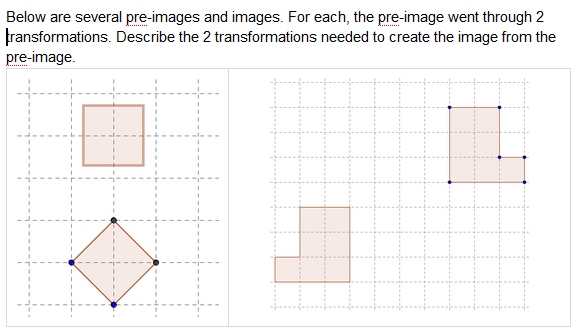
I gave them examples of transformations asking them to identify and describe the transformation that had occurred.
Here the questions began, but often they were addressed to another student and not to me, "the teacher." I kept marching on, letting students work in small groups at their own pace. I asked questions forwards and backwards, inside and out, anyway that I could think of to let students more fully explore and create their own understanding.

The result was a solid 2-3 week unit. The unit needs revision, but it worked well especially for a first iteration. All of my files can be found in a Google Doc folder, the naming convention is a bit non-conventional, but hopefully it is clear enough. Any comments or suggestions would be welcome.

To give credit where credit is due, many of the ideas and some of the questions came from Visual Math. All of the images were created by Geogebra. 

For those who prefer bullet points:

Topics addressed
  • Translation, rotation about a point, reflections across lines
  • Dilation in one direction and two, by negatives and by values less than 1
  • Vectors as a way of describing translations
  • Transformations of coordinate points
  • How to find the point of rotation
  • How to find the line of reflection
What was awesome?
  • It was nearly 100% student centered.
  • Students could work at their own pace resulting in varying amounts of homework
  • Homework was at a minimum, students worked and learned socially not in isolation
  • My students are solid on ideas of translation, reflection and dilation - all ideas they'll encounter again with functions
What was less than awesome?
  • Treatment of vectors was superficial - need quality problems to reinforce their use(fulness). 
  • Rotation bits were rough, but not terrible. Could be fleshed out more.
  • Finding the point of rotation and line of reflection were in the form of "follow these directions" not a structured or scaffolded inquiry 
  • I need more open ended investigative questions for the students to explore and extend their understanding - These could function as a final assessment
  • Ideas of symmetries could/should be added