Showing posts with label Inquiry. Show all posts

September 14, 2012

What Got Me Thinking - Sept 14

Whiteboarding Mistake Game: A Guide - A great addition to whiteboarding in class. A long post, but worth the read.

Clever Hans - A story of a clever horse that "could do math" and a reflection on how it could and should change what we do as (math) teachers.

"The Exeter (Math) Series" - A series of posts on Exeter Math. Includes many resources, discussions of pedagogy and much more. A must read for those interested in Exeter Math.

The World of Mathematical Reality - via Keith Devlin

September 06, 2012

Robots & Calculus - Part 1

As part of SL Math I have to teach Kinematics, last year I sort of rushed through it. I was too easily convinced by the smiles and nods that learning was happening. In calculus, I've never felt like my students accomplished much more than simply learning a series of steps to get the right answer. Sure they can solve the problems and most of my kids got very good IB scores last year. But! I wanted more.

Too often in SL Math kinematics is window dressing and an excuse for context on a calculus problem and rarely more than that. As a physics guy I see kinematics as the driving motivation behind differential calculus. So this year I swore I'd actually walk the talk. In come the robots!


My school, like any other, has its problems, but we are blessed with dreamers and an administration that are willingly to fund those dreams. 4000 euros later we have lego robots coming out our ears. Our school already supports two FTC teams, one middle and one high school team, so it wasn't a stretch to find more funding for robots.

The students were given about 40 minutes to create their "car" with the two stipulations that it had one motor and allowed for easy removal of the NXT brick (so other classes could use the brick).


And now for the calculus...

Part 1 - Constant Velocity

I pre-programmed 7 functions for the students. The first 3 are constant velocity functions. Student's used Logger Pro's video capture and analysis features to create position and velocity graphs and equations for each function.

Students wrote each set of equations on the board so as a class we had more data from which to make conclusions. I proceeded  to math-teacher-ninja them to see that the slope of the velocity equations was virtually zero when compared to the other parameters. Then the jump to see the similarity in the slope of the position and the constant value of the velocity was quick and easy. Leaving the students to conclude (written in my 2-grade hand writing):

If s(t) is linear then v(t) is constant.  Velocity is the slope of position.
If s(t) is linear then v(t) is constant.  Velocity is the slope of position. 

What more could a teacher ask for?

After these conclusions the students worked some very simple problems. Working with equations, graphs and most importantly writing rules to go from linear position to constant velocity and vice versa. I dangled the idea of the integration constant in front of them, not looking for full understanding, but trying to raise awareness that information was lost or is missing when moving back and forth between position and velocity.

Next up: Linearly increasing velocity in Part 2. Coming soon...

July 31, 2012

The Class I Always Wanted


In high school and college, being the nerd that I am, I always dreamed of a fantastic course where I and other students simply got to ask cool questions and where we were given the time, resources and space to find the answers. I dreamed of learning to program something that I wanted create - not being told what to create. I dreamed of building a robot or a contraption that did nothing useful but was fun and challenging. I dreamed of a true nerd elective where problems came first and solutions came second, where problems came from creativity and solutions came from a desire to learn and not from a lecture.

Next year I get to create that course. I get to teach a Nerd Elective! The course was created on the premise that many students at my school were not being challenged with the current math and science structure. We have the beginnings of a robotics program and the resources to support it. The stage is set. Now all I have to put the structure together and create the environment for the students to thrive in...

The Plan So Far...

  • I will give a brief intro to some ideas: Lego robots, iPad app development, Flash programming, Kodu Game Lab (maybe) and anything else I can find in the next 5 weeks. 
  • Students will create their own question or project including time frames with goals, deadlines and expected challenges. 
  • Students will work alone or hopefully in groups of 2. 
  • Final choice of projects and deadlines will be supervised and negotiated. 
  • Projects MUST be interesting to the STUDENT. 
  • Student will create a record (blog?) of there work including discoveries, progress and challenges.  

What I need...

  • Framework to foster creativity and maintain accountability. 
    • Rubrics to grade student work?
    • Reasonable expectations for students. 
  • More project platform ideas. 
  • General advice. What am I not thinking about? 

May 22, 2012

Introducing Radians

I usually introduce Radians via the unit circle making an theatrical argument that degrees come from Babylonian religious views regarding numbers with lots of factors and their base-60 number system (all true or at least plausible as far as I know). This begins to make the argument that maybe a better system could be devised, one based on logic and geometry, but this approach has always fallen short of allowing the students to make the jump to radians.

So last year I began to experiment with sectors to build up arguments that arc-length and radius determine the angle. I saw some success, but I had left it too unstructured for the students to reach a meaningful conclusion. When I tried to make a jump to radians I got a lots of looks that said, "I got what we just did, but what does THIS have to do with THAT?"

This year I gave the sector thing another shot, but this time narrowing what I asked them to look at. I defined arc-length and a sector and got them working on tasks like:

At this point I asked them to create an equation relating arc-length, radius and the angle. A few arguments broke out (Awesome!), a few questions were asked and virtually all of the students wrote down something akin to:


From this I asked the question "if you know the arc-length and the radius can you tell me the angle?"  I had the students draw a sector whose arc-length and radius ratio was 2 and then measure the angle... Each student had a different sized sector but all had the same angle. This lead to a conversation about ratios where a student pointed out that: 


Awesome! 

With a little math teacher magic, and no mention of radians, by the end of the 65-minute period I had most of the students agreeing that:


The next class we talked about the "arc-length" of a full circle. We worked our way around the unit circle talking about half and quarter circles before jumping into smaller angles and coming up with radian equivalents for the typical 30-45-60 angles. Only at the end did I finally mention the name "radian." 

I've followed this up with a few "Pop Quizzes" that were not graded, but just a bit of practice estimating and sketching angles in radians. Quiz 1 and Quiz 2. 

The result is the least confused class I've ever had. Dealing with radians still takes some effort, but they seem to get it.

My handout with the sectors can be found here via Google Docs. The rest of my trig bits (a work in progress - isn't everything?) are in a Google Doc/Drive collection. 


March 12, 2012

Harkness Method

I am currently rather obsessed with Exeter Math and their Harkness Method/Philosophy. I am intriqued by how simple and different it is from the likes of the Khan Academy (or rather the philosophy that seems to guide KA).

I found this great short video. I'll let it speak for itself.


More Goodness:

This is what is meant by an educational philosophy, this is what KA is missing. A "good" explanation by a teacher does not equate to real student learning. 

March 08, 2012

Exeter Math

I recently (re)discovered the Exeter Math books. I had seen them once before but apparently didn't think twice about them. Now I can't get seem to get enough of them. I've been obsessed all week.

The books are simply problem sets. Designed to be done in order and more or less completely. No mindless context free pictures. No chapters. No definitions. No glossy pages with theorems. The questions are not even broken up by topic. The books are just filled with math problems.

Exeter runs them under/with their Harkness Philosophy. They describe it better than I can, but it's highly student centered, which in my book makes it worthy of more research if not emulation.

Some of the problems are not unlike word problems in a typical text, some are very tough and some are gems that can be solved half a dozen different ways. My favorite so far is:
This is a modified version I used in a exam, but its the same idea.
Rich Beveridge also describes his solution to the problems below that involved Fibonacci numbers and Phi.


The problem sets appear to be a potential backbone for true continuum of math classes. No more starting off on Chapter 1 of a new book just because its September. Topics truly spiral through the problems sets. No more boring the bejeebers out of the kids by doing 20 problems that are exactly the same. I see so much potential...

Take a look at the books, see what you think.

Update: Glenn Waddell posted a great series on Exeter math. He's got great insight into Exeter's pedagogy and has posted more resources than are available on Exeter's homepage.

March 06, 2012

How I Taught Geometric Transformations

Starting geometric transformations I had two goals. 1) Be as student centered as possible. 2) Get the kids to do a bunch of mental gymnastics.

I wanted my students to develop their own understanding of the ideas surrounding translation, dilation and rotation. I did not want to rush them from the concrete to the abstract. They worked in small groups, 3 or 4, a few choose to work more or less alone. I didn't explain a thing to them, at least not as a whole class. I simply showed them examples of transformations and asked them to describe the results and create the rules...
I continued on like this with each type of transformation. The students did not find them difficult, but I was also never asked "whats a _______ transformation?"

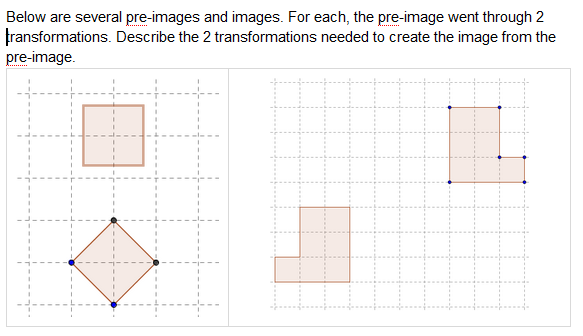
I gave them examples of transformations asking them to identify and describe the transformation that had occurred.
Here the questions began, but often they were addressed to another student and not to me, "the teacher." I kept marching on, letting students work in small groups at their own pace. I asked questions forwards and backwards, inside and out, anyway that I could think of to let students more fully explore and create their own understanding.

The result was a solid 2-3 week unit. The unit needs revision, but it worked well especially for a first iteration. All of my files can be found in a Google Doc folder, the naming convention is a bit non-conventional, but hopefully it is clear enough. Any comments or suggestions would be welcome.

To give credit where credit is due, many of the ideas and some of the questions came from Visual Math. All of the images were created by Geogebra. 

For those who prefer bullet points:

Topics addressed
  • Translation, rotation about a point, reflections across lines
  • Dilation in one direction and two, by negatives and by values less than 1
  • Vectors as a way of describing translations
  • Transformations of coordinate points
  • How to find the point of rotation
  • How to find the line of reflection
What was awesome?
  • It was nearly 100% student centered.
  • Students could work at their own pace resulting in varying amounts of homework
  • Homework was at a minimum, students worked and learned socially not in isolation
  • My students are solid on ideas of translation, reflection and dilation - all ideas they'll encounter again with functions
What was less than awesome?
  • Treatment of vectors was superficial - need quality problems to reinforce their use(fulness). 
  • Rotation bits were rough, but not terrible. Could be fleshed out more.
  • Finding the point of rotation and line of reflection were in the form of "follow these directions" not a structured or scaffolded inquiry 
  • I need more open ended investigative questions for the students to explore and extend their understanding - These could function as a final assessment
  • Ideas of symmetries could/should be added

February 21, 2012

Digesting a Math Conference

I am trying to digest and process my experience from an IB Math conference this past weekend. This was also my first time in a small room with so many other math teachers (Scary!).

Comments, ideas and the like that surprised me or caught my attention:
  • Teachers are most scared of "Inquiry" because of time constraints. 
  • We discuss "speed" or "efficiency" in a classroom with no clear definition of those terms. 
  • We need (successful) Inquiry and Student-Centered classrooms to be modeled, not simply written about.
  • Many teachers are concerned about "cheat sheets" and students NOT memorizing.
  • Teachers seem to attribute significant importance to memorizing.
  • Many teachers talk negatively about student abilities. 
  • The IB has goals for students beyond getting high marks yet, many teachers seem heavily focused on (internal/external) assessment results. 
  • Teachers seemed hungry for a recipe to "write labs" or to "teach an idea" suggesting discomfort with vagueness. 
  • Teachers have a knee-jerk reaction to "why are we doing/learning this" and to "when will we ever use this?"
  • While the IB is very aware, I was not aware of the apparent divide or conflict between the IB Learner Profile and the way IB Math is (often) getting taught.
Well there you have it. I will readily admit that I am reading into many comments and conversations making quasi-conclusions based on my own biases and preferred lingo. I have no way of knowing what these teachers classrooms are really like, but still I left feeling discouraged.

If nothing else the conference got me thinking.