March 12, 2012

Harkness Method

I am currently rather obsessed with Exeter Math and their Harkness Method/Philosophy. I am intriqued by how simple and different it is from the likes of the Khan Academy (or rather the philosophy that seems to guide KA).

I found this great short video. I'll let it speak for itself.


More Goodness:

This is what is meant by an educational philosophy, this is what KA is missing. A "good" explanation by a teacher does not equate to real student learning. 

Khan Academy: Good or Bad. It's not THE gold standard.

Like many other's I watched the recent Khan Academy piece on 60 minutes. Everyone has their opinion on the Khan Academy (I certainly do) ranging from thinking it's a God sent educational revolution to thinking quite the opposite.  Yet, might both be true?

Watch on YouTube at http://youtu.be/zxJgPHM5NYI
If you think school and education should consist of talking at students for the better part of the period and then having them answer questions nearly identical to what you just showed them, then KA is potentially an improvement. No more lectures to prepare, no more examples to walk through, just time and energy to mingle giving help and advice as you go. If your classes have 30+ kids maybe this is a realistic (or only) way of spending some time with each student or having a better chance to individualize instruction. I remember my public school classrooms and full implementation of KA would have been a vast improvement.

Or if you think school and education should consist of students drawing conclusions in their own words and creating their own understanding then KA is nothing new its just more of the same albeit in digital/rewindable form. If you believe that learning is evidenced by transfer of knowledge not simply the recall of knowledge then the KA is a horrible idea. If you already spend the majority of class time sitting next to students engaging them in conversation about what they understand and what they don't understand then KA is a huge step backwards.

Sometimes beauty is not the only thing in the eye of the beholder...

However, after trying to digest all the fervor over the KA, I have one remaining complaint. The KA is being put out there as the gold standard as the best that can be done. The KA might be better than some are doing but it is not the top of the educational food chain. I would challenge Sal Khan (or Bill Gates, the $$$ for KA ) to go visit a truly student-centered classroom. Go watch Dan Meyer or Frank Noschese in action. What about the Exeter Math program? Before you declare you have THE solution go see what other solutions exist.


March 08, 2012

Exeter Math

I recently (re)discovered the Exeter Math books. I had seen them once before but apparently didn't think twice about them. Now I can't get seem to get enough of them. I've been obsessed all week.

The books are simply problem sets. Designed to be done in order and more or less completely. No mindless context free pictures. No chapters. No definitions. No glossy pages with theorems. The questions are not even broken up by topic. The books are just filled with math problems.

Exeter runs them under/with their Harkness Philosophy. They describe it better than I can, but it's highly student centered, which in my book makes it worthy of more research if not emulation.

Some of the problems are not unlike word problems in a typical text, some are very tough and some are gems that can be solved half a dozen different ways. My favorite so far is:
This is a modified version I used in a exam, but its the same idea.
Rich Beveridge also describes his solution to the problems below that involved Fibonacci numbers and Phi.


The problem sets appear to be a potential backbone for true continuum of math classes. No more starting off on Chapter 1 of a new book just because its September. Topics truly spiral through the problems sets. No more boring the bejeebers out of the kids by doing 20 problems that are exactly the same. I see so much potential...

Take a look at the books, see what you think.

Update: Glenn Waddell posted a great series on Exeter math. He's got great insight into Exeter's pedagogy and has posted more resources than are available on Exeter's homepage.

March 06, 2012

How I Taught Geometric Transformations

Starting geometric transformations I had two goals. 1) Be as student centered as possible. 2) Get the kids to do a bunch of mental gymnastics.

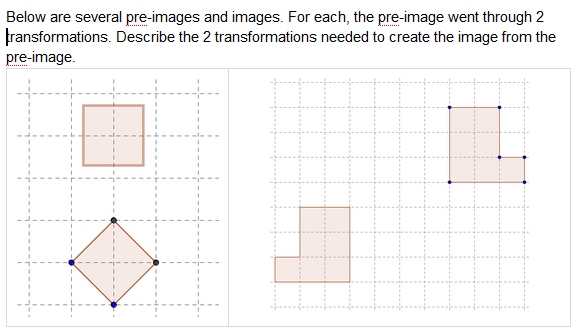
I wanted my students to develop their own understanding of the ideas surrounding translation, dilation and rotation. I did not want to rush them from the concrete to the abstract. They worked in small groups, 3 or 4, a few choose to work more or less alone. I didn't explain a thing to them, at least not as a whole class. I simply showed them examples of transformations and asked them to describe the results and create the rules...
I continued on like this with each type of transformation. The students did not find them difficult, but I was also never asked "whats a _______ transformation?"

I gave them examples of transformations asking them to identify and describe the transformation that had occurred.
Here the questions began, but often they were addressed to another student and not to me, "the teacher." I kept marching on, letting students work in small groups at their own pace. I asked questions forwards and backwards, inside and out, anyway that I could think of to let students more fully explore and create their own understanding.

The result was a solid 2-3 week unit. The unit needs revision, but it worked well especially for a first iteration. All of my files can be found in a Google Doc folder, the naming convention is a bit non-conventional, but hopefully it is clear enough. Any comments or suggestions would be welcome.

To give credit where credit is due, many of the ideas and some of the questions came from Visual Math. All of the images were created by Geogebra. 

For those who prefer bullet points:

Topics addressed
  • Translation, rotation about a point, reflections across lines
  • Dilation in one direction and two, by negatives and by values less than 1
  • Vectors as a way of describing translations
  • Transformations of coordinate points
  • How to find the point of rotation
  • How to find the line of reflection
What was awesome?
  • It was nearly 100% student centered.
  • Students could work at their own pace resulting in varying amounts of homework
  • Homework was at a minimum, students worked and learned socially not in isolation
  • My students are solid on ideas of translation, reflection and dilation - all ideas they'll encounter again with functions
What was less than awesome?
  • Treatment of vectors was superficial - need quality problems to reinforce their use(fulness). 
  • Rotation bits were rough, but not terrible. Could be fleshed out more.
  • Finding the point of rotation and line of reflection were in the form of "follow these directions" not a structured or scaffolded inquiry 
  • I need more open ended investigative questions for the students to explore and extend their understanding - These could function as a final assessment
  • Ideas of symmetries could/should be added

February 28, 2012

Pseudo Context Minus the Context?

Saw this gem in my textbook today. It's maybe the third or fourth time this year I have cracked the book. This was a good reminder why I do it so infrequently...


The only thing that is decaying is our student's attention or their hope that math class might be remotely interesting.


February 21, 2012

Digesting a Math Conference

I am trying to digest and process my experience from an IB Math conference this past weekend. This was also my first time in a small room with so many other math teachers (Scary!).

Comments, ideas and the like that surprised me or caught my attention:
  • Teachers are most scared of "Inquiry" because of time constraints. 
  • We discuss "speed" or "efficiency" in a classroom with no clear definition of those terms. 
  • We need (successful) Inquiry and Student-Centered classrooms to be modeled, not simply written about.
  • Many teachers are concerned about "cheat sheets" and students NOT memorizing.
  • Teachers seem to attribute significant importance to memorizing.
  • Many teachers talk negatively about student abilities. 
  • The IB has goals for students beyond getting high marks yet, many teachers seem heavily focused on (internal/external) assessment results. 
  • Teachers seemed hungry for a recipe to "write labs" or to "teach an idea" suggesting discomfort with vagueness. 
  • Teachers have a knee-jerk reaction to "why are we doing/learning this" and to "when will we ever use this?"
  • While the IB is very aware, I was not aware of the apparent divide or conflict between the IB Learner Profile and the way IB Math is (often) getting taught.
Well there you have it. I will readily admit that I am reading into many comments and conversations making quasi-conclusions based on my own biases and preferred lingo. I have no way of knowing what these teachers classrooms are really like, but still I left feeling discouraged.

If nothing else the conference got me thinking. 

February 09, 2012

Filing Cabinet

In the spirit of sharing and maybe getting some feedback and at the risk of overwhelming others I have shared my collection of files. So far just the ones in Google Docs... There are a few in Dropbox but they are making their way in to GDocs as PDFs.