The moment students realize they can't just memorize their way through math class is a special moment. The moment students know that they need to "understand' not just remember is one of my favorite moments as a teacher. Today that moment occurred!
My IB Math kids just saw IB questions for the first time... They were almost annoyed that they needed to go look through past notes. Seeing problems that didn't scaffold the 3 steps to get to the answer. Seeing that they will need to THINK!
Awesome.
September 15, 2011


April 26, 2011
What do you do when...?
What do you do when 4-5 students in a precalculus course are asking what a cubic or even worse a quadratic equation is? Me? My jaw dropped. I was nearly speechless. My response was on the verge of disrespect/disbelief I simply couldn't wrap my head around the idea.

How in the world have they made it this far in math and they can't identify a cubic, quadratic or exponential equation?
For a good while I felt like the most awful teacher. Here I had them looking at limits and how fast functions approach infinity and they don't know the difference between a quadratic and a cubic function. Then I thought, wait I didn't teach them those functions... I can blame the other guy. With the finger pointing done, I thought about how cool it was they were understanding complex ideas like limits!
Adding to that list I think this is, to some extent, an indication of the state of math education. I care about vocabulary only so far as it allows my students and I to have a conversation using words not just symbols. My students know how to deal with quadratics on paper they just don't know what they're called.
I have never done "matching" on a test. I think my next quiz will have a vocab matching section...

How in the world have they made it this far in math and they can't identify a cubic, quadratic or exponential equation?
For a good while I felt like the most awful teacher. Here I had them looking at limits and how fast functions approach infinity and they don't know the difference between a quadratic and a cubic function. Then I thought, wait I didn't teach them those functions... I can blame the other guy. With the finger pointing done, I thought about how cool it was they were understanding complex ideas like limits!
Adding to that list I think this is, to some extent, an indication of the state of math education. I care about vocabulary only so far as it allows my students and I to have a conversation using words not just symbols. My students know how to deal with quadratics on paper they just don't know what they're called.
I have never done "matching" on a test. I think my next quiz will have a vocab matching section...
April 19, 2011
Follow Up: Sequence Intro
Oh how a trip to Target can lead to good things in the classroom!
I came up with a few ideas for many students to play with to get them started playing with sequences. A little tactile learning if you will... They even went a bit into the idea of series with out them really knowing (or caring).
I had them try to make a stack of ping pong balls 4 layers high with the least number of ping pong balls. (I was very careful in the write up to always say "ping pong balls" not just "balls." Just a bit of classroom management.) This of course led them all to the same solution of creating a triangular pyramid. They looked at the number of ping pong balls in each layer and how the number in each layer increased. I really like the idea of setting a challenge that would lead them to a solution, sure wish I could have figured out more of those!
I also had them look at "stacking circles" (i.e. poker chips). They placed one chip and then surrounded it with rings of different colored chips (just for visual separation between layers).
Both of the ping pong balls and poker chips were fun and tactile, but the patterns were a little difficult for them to describe in a more formal way (read: with an equation). The poker chips were difficult if you include the original chip... So ala Jo Boaler (a book well worth reading) I had them move on to geometric patterns using foam squares, made from foam sheets I picked up at Target in the craft and scrap booking section.

With the foam squares they could get a little more analytical, as the patterns followed function forms they were familiar with (linear, quadratic and exponential). They made tables of numbers, graphed the results and final were able to create equations to describe the patterns.
Reflection on the process: A few students really enjoyed the change to a bit of tactile learning, something I really need to remember. The process of making connections from squares to table to graph to equation (i.e. from concrete to abstract) was, I think, highly valuable. That process is at least closer to "real math" or "real science." It also served to slow down some of the folk who like to jump straight to the equation, thinking equations are what math is all about.
The handout I gave the students is a google doc.
I came up with a few ideas for many students to play with to get them started playing with sequences. A little tactile learning if you will... They even went a bit into the idea of series with out them really knowing (or caring).
I had them try to make a stack of ping pong balls 4 layers high with the least number of ping pong balls. (I was very careful in the write up to always say "ping pong balls" not just "balls." Just a bit of classroom management.) This of course led them all to the same solution of creating a triangular pyramid. They looked at the number of ping pong balls in each layer and how the number in each layer increased. I really like the idea of setting a challenge that would lead them to a solution, sure wish I could have figured out more of those!
 |
| Stacked ping-pong balls |
 |
| Poker Chips in rings |

Reflection on the process: A few students really enjoyed the change to a bit of tactile learning, something I really need to remember. The process of making connections from squares to table to graph to equation (i.e. from concrete to abstract) was, I think, highly valuable. That process is at least closer to "real math" or "real science." It also served to slow down some of the folk who like to jump straight to the equation, thinking equations are what math is all about.
The handout I gave the students is a google doc.
April 04, 2011
Exploring patterns
Back from spring break, time to get chugging...
I am getting close to starting sequences and series with my kids, probably do that by the end of the week. I have my usual inquiry style group work put together from last year, but its pretty boring. Not as boring as me standing up in front of the kids for 2 periods, but not awesome. I want to find something more interesting to start with, then I'll go back to what I did (successfully) last year.
I've been searching the inter-webs for ideas. Patterns the kids can build or observe on the desk in front of them. I see the usual suspects of the sea shells and Fibonacci...
Textbooks suggest the always exciting interest rate based problems. I can already see the eye lids drooping and the drool starting to flow. The books also had some brick stacking problems (which might work) or the oh-so inspiring stadium seating problems...
I'm looking for something that can be posed as a challenge to create something that's not 100% obvious. I want the kids to create something, have I said that yet? So far my candidates are:
I am getting close to starting sequences and series with my kids, probably do that by the end of the week. I have my usual inquiry style group work put together from last year, but its pretty boring. Not as boring as me standing up in front of the kids for 2 periods, but not awesome. I want to find something more interesting to start with, then I'll go back to what I did (successfully) last year.
I've been searching the inter-webs for ideas. Patterns the kids can build or observe on the desk in front of them. I see the usual suspects of the sea shells and Fibonacci...
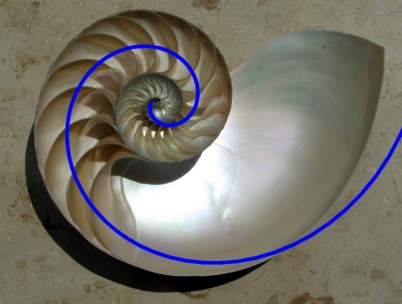 |
| The curve doesn't fit... How am I suppose to convince students it does? And why would I? |
Textbooks suggest the always exciting interest rate based problems. I can already see the eye lids drooping and the drool starting to flow. The books also had some brick stacking problems (which might work) or the oh-so inspiring stadium seating problems...
I'm looking for something that can be posed as a challenge to create something that's not 100% obvious. I want the kids to create something, have I said that yet? So far my candidates are:
- Sphere stacking - Stack x number of spheres to create the tallest structure.
- Packing circles (creative I know) - start with one penny, completely surround it, surround those...
- Dilution of liquid - dy/dan style I love the potential to explore the idea of limits
- Mowing lawn or harvesting hay in increasing or decreasing circles
- Stacking blocks - Stack x number of blocks on top of a single block to create the shortest possible structure
- Creating a spiral out of square blocks
I may also explore going in different directions. Such as giving an equation and asking them to create a visual representation of the pattern. This could be done with linear, quadratic equations even exponential...
Another option would be for me to create a pattern on paper, have the students expand the pattern and create a mathematical model...
Any thoughts and particularly any ideas would be greatly appreciated.
March 04, 2011
"Prop Lab"
Since I started teaching Physics I always wanted to have good labs. I tried the usual do this, then this, write down this bit of info... Every lab report turned out the same. The only real variety came from the very best and the very worst students. Not exactly best teaching practice. Not to mention they were painful to grade. And what were my students learning? How to follow directions? Yeah, that's what science is, following a recipe.
When I started doing "Prop Labs" I was sold on the idea. I can't claim to be the brain behind the idea, I can only claim to be a groupie gulping the kool-aid. The idea is to give the students a "prop" and then let them have at it. The goal is to let them create the research question, let them create the procedure and let them figure out how to process the data and draw a conclusion. It's also most like real science! Don't get me wrong, I provided scaffolding in terms of general brainstorming and giving approval on questions so as not to "waste" several days. I also wrote a lab guide and modified old IB rubrics to help guide them through the details. The ideas kids come up with are often ideas I'd never think of. Now that's real science.


In the past I've given them props such as magnets, springs, rubber bands, balloons, clay, electric motors and vernier probes. If I can think of 7-8 solid ideas for a prop then its probably a good prop, if I can't come up with no more than 5 then its probably a no-go, however sometimes I'll give more than one prop which can make use of a just "okay" props. In the past student ideas for clay have included:
- Drop height vs. dent diameter in a sphere of clay
- Temperature vs. dent diameter in a sphere of clay
- Coefficient of friction vs. temperature
- Resistive force (to a string pulling through the clay) vs. temperature
The first time a class does a prop lab, they look at you like your crazy, like your asking them to do the impossible. By the second or third time around they're in the groove and chugging along. Pretty awesome, but you do have to be prepared for the push-back.
The outcomes are not always stellar, but most of the class, at least 80%, come up with great ideas and are able to gather interesting data and draw a conclusion. Its amazing.
February 16, 2011
Floating and Sinking
I never really thought of floating and sinking as a physics topic until I saw it done up at MSU in Bozeman in the introductory physics classes. Sure seemed pretty simple... Oh boy was I wrong. It was consistently the unit that gave people fits. While I don't want to drag my students through something hard for the sake of being hard, I do think a challenge is good for them.
So this year my class is cruising along much faster than last year so I'd been thinking I'd toss in some floating and sinking to occupy a week or so of class. It's something that they have experience with, that is assuming they've been in a bathtub or swimming pool before.
When I saw that the PhET folk had created a floating and sinking simulation I was sold on the idea.
The simulation does just about everything I would want it to do. It allows you to use 4 or 5 different material blocks and allows a continuum of densities for the fluid. It also comes with 2 scales, that can be moved, and function in the water and out of the water.
I did my usual which is to have the students work through some guided inquiry type questions. Seemed to work great for most, a few hiccups here and there. The questions could use some refinement, but in the end they picked up on the two main ideas. That is that floating objects displace their mass in water. Sinking objects displace their volume. That's good a start as far as I'm concerned.
So this year my class is cruising along much faster than last year so I'd been thinking I'd toss in some floating and sinking to occupy a week or so of class. It's something that they have experience with, that is assuming they've been in a bathtub or swimming pool before.
When I saw that the PhET folk had created a floating and sinking simulation I was sold on the idea.
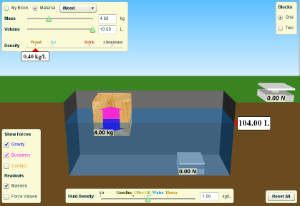 |
| http://phet.colorado.edu/en/simulation/buoyancy |
I did my usual which is to have the students work through some guided inquiry type questions. Seemed to work great for most, a few hiccups here and there. The questions could use some refinement, but in the end they picked up on the two main ideas. That is that floating objects displace their mass in water. Sinking objects displace their volume. That's good a start as far as I'm concerned.
February 07, 2011
Going where?
Lately, I've been a bit quiet in terms of posts. We had been preparing to go to an international job fair...
Its finally over. We accepted jobs 48 hours ago and I'm still recovering from the stress of the fair. Holy cow. It went great, so much better than two years ago, but it still aged me a good bit. Now the challenge is to stay focused for the last 4 months of the current school year. Could be tough.

The new spot is as a pure math teacher. No physics. The upside is it's IB Math, which I've taught before, but only the lowest tier. So it'll be great resume padding, not to mention a fun challenge. Hopefully some (IB) physics classes will come my way over the next year or two in addition to the IB Math.
Subscribe to:
Posts (Atom)